
You’ve had a scan for hip pain, and the report says a “labral tear” or “impingement”. What does that mean for your next gym session, your daily commute, or the walk you usually take after dinner?
Here’s the short answer: The scan describes your hip. The assessment helps explain your pain. Together, they help identify what’s likely contributing to your symptoms and what you can do next.
What is a hip labral tear?
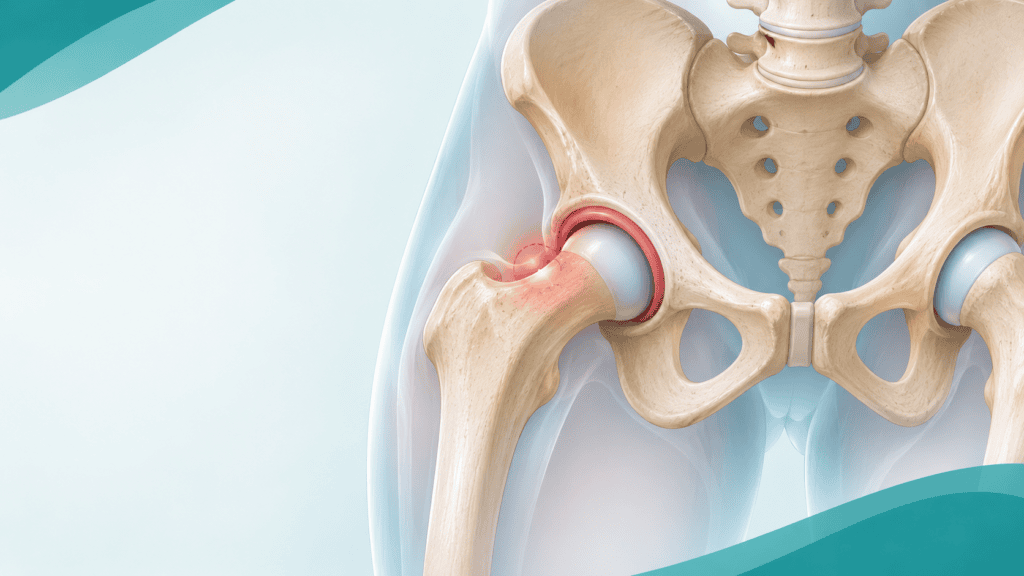
Your hip is a ball-and-socket joint. The ball at the top of your thigh bone sits in a socket in your pelvis. Around the rim of that socket is a ring of firm cartilage called the labrum. It deepens the socket and helps form a seal around the joint. A labral tear means the scan shows a split or damaged area in that ring.
People with a labral tear can have deep groin pain or a catching sensation when they move. Labral tears also show up on scans of people whose hips feel fine. One review found them in about half of the people without hip symptoms. So when we read your report, we look for a match: do the location of your pain, the movements that bring it on and the findings from your physical assessment point to the hip joint?
What does “hip impingement” mean?
Impingement refers to how the ball and socket meet during certain movements. Your report might use the words cam or pincer to describe the shape of the joint.
- A cam shape means the ball is less round where it joins the neck of the thigh bone.
- A pincer shape means the socket covers more of the ball than usual.
These shapes can affect how much room your hip has when you bend or turn it. When the shape on your scan fits both your symptoms and your physical examination, a clinician may call it femoroacetabular impingement syndrome, or FAI syndrome.
For example, you might feel a familiar pinch deep in the groin every time you get out of a low car seat. If bending and turning your hip during the assessment brings on that same pinch, the scan finding may help explain why that movement bothers you. The key is recognising your usual pain, not simply finding a position that feels uncomfortable.
What happens at a physiotherapy assessment?
We start with the things you notice in everyday life. How long can you sit before the soreness comes on? Does it hurt when you bend to put on your shoes? If squatting bothers you, does the pain start halfway down or only at the bottom? These details help us choose what to assess and give us a starting point for measuring progress.
We may check how your hip moves, assess your strength and watch you do a task that’s been difficult. We may also look at your lower back, or the muscles and tendons around the hip, to see whether they could be contributing. By the end of the assessment, we aim to give you a clear plan for next steps: what you can keep doing, what to adjust for now and what to work on first.
Can I keep exercising?
In many cases, you can stay active by changing the part of an activity that brings on your symptoms. For example, if the bottom of a squat gives you a sharp pinch, try squatting to a higher bench for now. That lets you keep training the movement at a depth your hip is more comfortable with.
Your physiotherapist may also suggest exercises to build strength around your hip and trunk. A bridge or a low step-up might be a starting point. As those exercises get easier and your hip responds well, you can gradually add resistance, increase the range or practise a movement that’s closer to what you want to get back to.
Progress should mean something to you. It might be getting through the MRT ride to work with less discomfort, putting on your shoes more easily or returning to your usual gym routine. Those changes tell us more about how rehab is going than the wording on your original scan.
Does this mean I need surgery?
A scan finding alone isn’t a reason to have surgery. For people with confirmed FAI syndrome, both physiotherapy and keyhole surgery are treatment options. In a large UK trial of people assessed as suitable for surgery, both groups reported better hip-related quality of life after a year. The surgery group improved more on average.
If pain or catching is still getting in the way after a structured course of rehabilitation, the next step is to review what’s limiting you and whether an orthopaedic opinion would be useful. That discussion starts with what you’re still struggling to do and how your hip has responded to treatment.
Will my hip get better, and how long will it take?
Many people with this type of hip pain improve without surgery. In a review of people with hip pain not caused by arthritis—including people with labral tears or hip impingement—about half had a satisfactory response to treatment without surgery. That means they improved enough for the result to be considered satisfactory, not necessarily that their pain went away completely. Your scan alone can’t tell you how likely you are to improve.
A useful time to review your progress is around 6 to 12 weeks after starting a structured rehab programme. That’s a check-in, not a deadline for recovery. We might look at whether you can sit through your train ride more comfortably, put on your shoes with less pain or squat a little deeper. Getting back to running or heavier gym training can take longer. If the activities that matter to you aren’t getting any easier, we’ll review what’s limiting you and decide whether to adjust the programme or seek another opinion.
What should I do with my scan report?
Bring it to your physiotherapy appointment and tell us one thing you’d like to do more comfortably. That gives us a starting point: we can explain how the scan relates to what you’re feeling, agree on what to work on first and set a time to review your progress. We measure your progress by how you feel and what you’re able to do over time, not by whether your scan looks different.
References
- Griffin DR, Dickenson EJ, O’Donnell J, et al. The Warwick Agreement on femoroacetabular impingement syndrome (FAI syndrome): an international consensus statement. British Journal of Sports Medicine. 2016;50(19):1169–1176.
- Zhang P, Li C, Meng H, et al. 3.0 T MRI is more recommended to detect acetabular labral tears than MR arthrography: an updated meta-analysis of diagnostic accuracy. Journal of Orthopaedic Surgery and Research. 2022;17:126.
- Probst DT, Sookochoff A, Harris-Hayes M, Steger-May K, Prather H. What is the rate of response to nonoperative treatment for hip-related pain? A systematic review with meta-analysis. Journal of Orthopaedic & Sports Physical Therapy. 2023;53(5):290–303.
- Wall PDH, Dickenson EJ, Robinson D, et al. Personalised Hip Therapy: development of a non-operative protocol to treat femoroacetabular impingement syndrome in the FASHIoN randomised controlled trial. British Journal of Sports Medicine. 2016;50(19):1217–1223.
- Griffin DR, Dickenson EJ, Wall PDH, et al. Hip arthroscopy versus best conservative care for the treatment of femoroacetabular impingement syndrome (UK FASHIoN): a multicentre randomised controlled trial. The Lancet. 2018;391(10136):2225–2235.